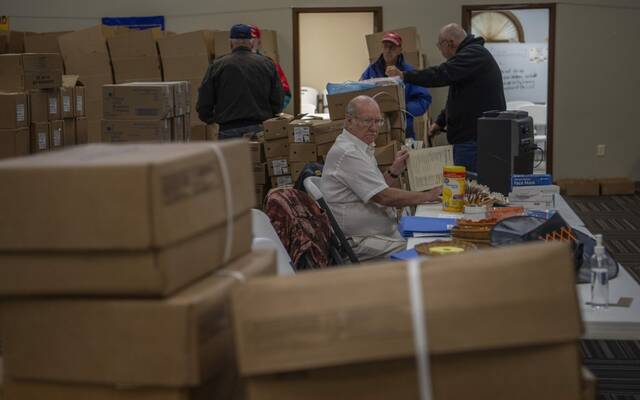

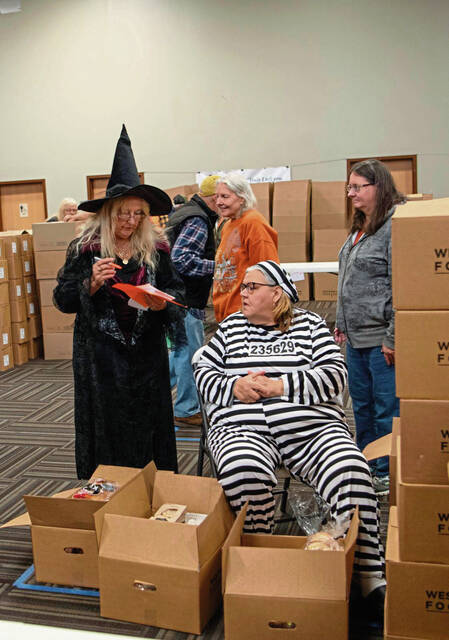
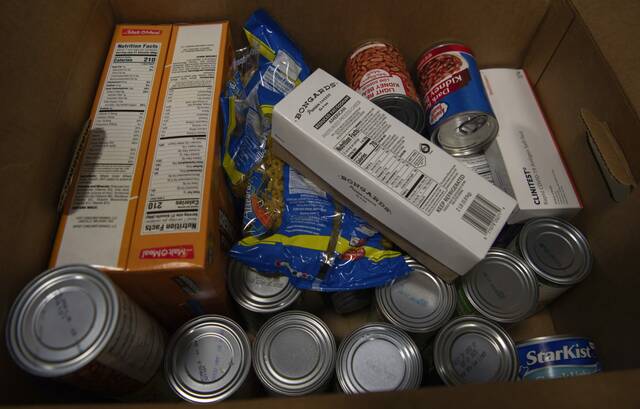
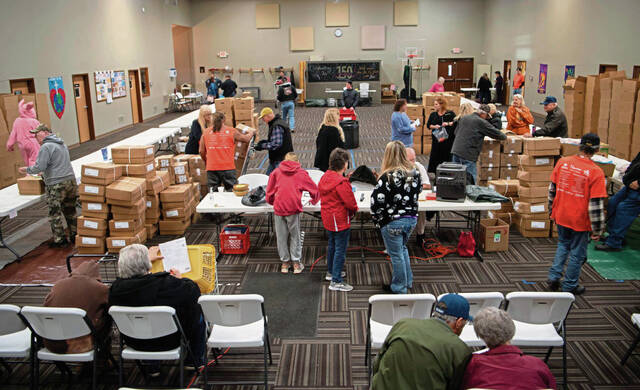
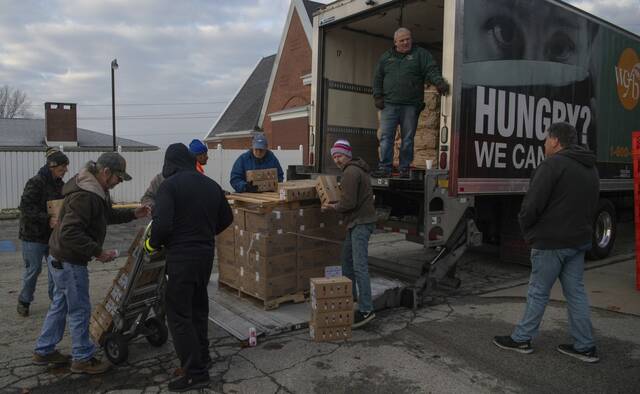



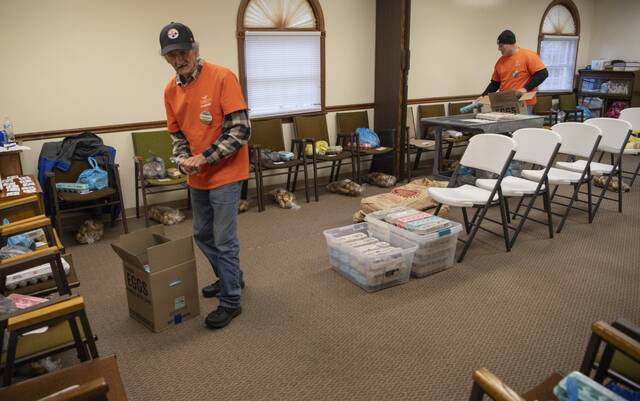










Every month, volunteers at the Mt. Pleasant Area Food Pantry see more and more unfamiliar faces.
“This is the busiest we’ve ever been. Not just my pantry but every pantry,” said Marie Ochaba, head coordinator of the pantry at Church of God on West Main Street. “I’m probably signing up 20 to 25 people more each month.”
Food bank leaders and food pantry organizers blame, in part, the discontinued covid-era emergency SNAP benefits for the increase in need. The additional allotment, which ended in March, granted households already getting Supplemental Nutrition Assistance Program benefits — the government program previously called food stamps — a second monthly payment.
That loss is compounded by inflation and the time of year — need typically increases during the holiday winter months, officials said.
“Even if you live in a (senior) high rise, you still have to pay rent,” Ochaba said. “You still have electric, you still have water, you still have gas, and you still have to buy groceries. I think cost of living is the highest (it’s been) — I can’t remember it ever being this high in my lifetime. If you go to the store, you go with $20, and you come out with one item sometimes.”
Last week, the national hunger relief nonprofit Feeding America released a report noting 1 in 6 people in the U.S. — 49 million people — sought charitable food assistance in 2022.
The number of people living in food-insecure households increased by 10 million people over the course of one year, the report said. That’s a jump of 31% for all individuals and 44% for children.
Higher numbers
From larger food banks to smaller church-based food pantries, need has remained high since the dawn of covid in 2020 and has experienced fluctuations since.
According to Jennifer Miller, CEO of Westmoreland Food Bank, the influx went down somewhat when people received increased SNAP benefits during the earlier parts of the pandemic, but it has now “come back tenfold.”
“We are seeing 8,000 families a month when we were normally seeing between 5,500 and 6,000 families (pre-covid),” she said. “We are down substantially in donated food product. We are also down in funds donated. Either form of donation is greatly appreciated right now.”
Inflation has hit food bank budgets the same as it has impacted their clients, Miller said. Even as food banks buy products at discounted prices, their funds don’t stretch as far as they once did.
“We used to say that for every dollar, we could purchase $10 worth of food. We can’t say that anymore. That dollar doesn’t go as far as it used to, and that is because of inflation,” Miller said. “It’s probably more like for every dollar donated, $5 or $6 can be purchased.”
Need tends to jump most at the end of the year, she said. Even so, the numbers for 2023 are above those for 2022. Last year, the food bank made 1,722 referrals, or new clients. This year, with two months to go, the food bank has made 1,862 referrals.
In 2022, 441 households requested emergency assistance from Westmoreland Food Bank, meaning they needed food immediately. So far in 2023, 520 households have sought that same emergency assistance.
At the start of the pandemic in fiscal year 2020, Greater Pittsburgh Community Food Bank served 40 million meals to its 11-county service area. This past fiscal year, the food bank served 42 million meals, spokesperson Christa Johnson said.
“We tend to see a higher need around the holidays, not just because of the holidays but because heating bills start to kick in, and they’re so unpredictable,” she said. “If we’re already at an all-time high, we can only imagine what things are going to be like.”
Increased need
At the Feed My Sheep food pantry at Forks Zion Lutheran Church near Leechburg, founder Nancy Wirick notes that numbers have climbed over the course of the past several years.
“Seven years ago, we started with just a couple families, and now we are up to 50 families a month,” she said. “That need has definitely grown.”
The food bank at Allegheny Valley Association of Churches in Harrison has been signing up new people each week, according to association Executive Director Karen Snair.
“We definitely are experiencing higher numbers than we have in years, even through the pandemic. It seems like we have more folks coming,” she said. “Food is so expensive, and folks were used to getting that extra pandemic money through their SNAP benefits, and now they are not.”
The Kiski Area Association of Churches food pantry gets more and more requests for help each week, said pastor Todd Ruggles.
“Since the end of (increased) SNAP benefits, we’ve been getting more calls mid-month asking for help, and people signing up,” he said. “Before, we used to get a few calls a month for people, but now, it’s more like a few calls a week of people asking for help.”
The pantry’s two locations have about 217 households needing assistance, he said.
“We’ve never seen that many before,” Ruggles said. “I’ve never seen this many people.”
Bigger-scale challenges
Ken Regal, executive director at Allegheny County food insecurity nonprofit Just Harvest, said although need has come down since the peak of the pandemic, it is worse than before covid. Unemployment has fallen, but SNAP numbers haven’t.
“Overall, when those numbers persist at these high record levels that they are at now, that’s an indication that the need has increased, not decreased,” he said. “As of September, 166,000 people were on SNAP in Allegheny County, and in December of 2019, before the pandemic, that was 147,000.”
Regal said the rise in food insecurity can’t be fixed by donating only to food banks.
“The scale of poverty and hunger is not a thing we can charity our way out of,” he said. “As generous as folks are, during the pandemic and not during the pandemic, this is a problem of vastly larger proportion than individual private charity can solve. The difference between the increased benefits during the pandemic and now works out to about $17 million a month in benefits that used to be available to people that aren’t anymore.”
He added that it’s “both tragic and morally outrageous” that the additional assistance programs from the covid era have disappeared.
“What we learned from those was that we’ve got the tools as a society in the federal government to dramatically decrease poverty and hunger as a basic issue for millions of people, and we chose during the pandemic to use those tools,” he said. “We learned that this solution worked, and we abandoned it.”