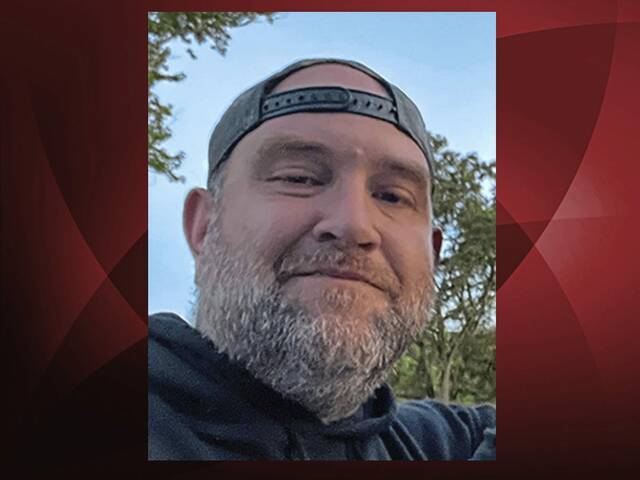






Barry Reeger eats healthy and exercises, just like the professional football players he photographs on Sundays at Acrisure Stadium.
But there’s a big difference in the Hempfield man’s repertoire that helps him keep up with the action on the field — eight hours of overnight peritoneal dialysis.
When his kidney function started to decline last year, Reeger knew he couldn’t juggle freelance photography work and going to a dialysis clinic multiple times a week.
“I wanted to continue to do what I love,” he said. “I have wanted to do this job since I was in junior high. … It’s my identity.”
Reeger, 55, has been able to maintain that career identity by opting for nightly dialysis at home. For eight hours, he is hooked up to a machine that uses a cleansing fluid and the inside lining of his abdomen as a natural filter to remove toxins, according to the National Kidney Foundation.
He is part of a growing number of patients who choose at-home dialysis while awaiting a kidney transplant. The number of new patients opting for that method in the U.S. has increased from 7.5% in 2011 to 13.4% in 2021, according to a National Institutes of Health report.
“I’m very thankful for the technology,” he said. “I like to be busy doing things.”
After managing Type 2 diabetes since 2003 with diet and exercise, routine blood work in January 2024 showed his kidney function was compromised. He later learned a kidney injury combined with diabetes had damaged the organs. The cause of the kidney injury remains a mystery.
Reeger started at-home treatments in April 2024 through Dialysis Clinic, Inc. in Hempfield and was added to UPMC’s transplant list four months later. Nearly 90,000 people nationwide were waiting for a kidney transplant in September 2024, the most of any organ, according to the Health Resources & Services Administration.
A private person, it’s been difficult for him to go public with such a monumental request in an effort to find a living donor, which is preferred over a cadaver donor.
“I try to be funny about it, I never come out and say ‘Hey, will you give me your organ,’ ” Reeger said with his distinctive laugh.
“I want to help out somebody else as much I would like to help myself,” he said. “It’s a weird thing to be asking people for their kidney.”
In addition to covering the Steelers on a freelance basis for a wire service, Reeger photographs Penn State University football games and local youth and high school sporting events. He does other contract work for the Associated Press, including covering Groundhog Day festivities in Punxsutawney, while also teaching photography classes at Seton Hill University and Westmoreland County Community College.
Some of those sports jobs can require down-to-the-minute planning when it comes to hooking up to the dialysis machine at home, such as a 3:30 p.m. Penn State home game on a Saturday followed by a 1 p.m. Sunday kickoff in Pittsburgh. On nights like that, Jennifer Reeger, 49, usually gets it ready for him.
“I need an honorary degree in nephrology,” she joked.
The couple, married since 1999, have two sons — Chase, 13, and Cameron, 23. Both previously worked at the Trib. Jennifer Reeger was a reporter from 1999 to 2013 and Barry was a photographer for 22 years before leaving in 2016.
“I spent 30 years in this business, I’ve been on the other side of this table” feeling sympathy for someone in need, Barry said during an interview last week. “I never thought I’d be one of those people.”
The Reegers hope to raise awareness about at-home dialysis and the need for living organ donors. Until that perfect match comes, they’ll continue to lean on each other, family and friends for support, and try to go about normal days, even if nothing is normal.
“I’m relying on a friend here,” he said. ” I need a friend to step up, or a stranger, who wants to do something good for somebody.”
Anyone interested in becoming a living donor through UPMC can register here and choose whether they want the donation to go to a specific person or anyone in need.