BELGRADE, Serbia — Serbia’s prosecutor for organized crime on Monday charged a government minister and three others with abuse of office and falsifying of documents to help pave the way for a real estate project linked to Jared Kushner, U.S. President Donald Trump’s son-in-law.
Proposed criminal charges were announced against Culture Minister Nikola Selaković, who is a close ally of autocratic President Aleksandar Vučić, and three other officials, according to a statement published on the official website of the Public Prosecutor’s Office for Organized Crime.
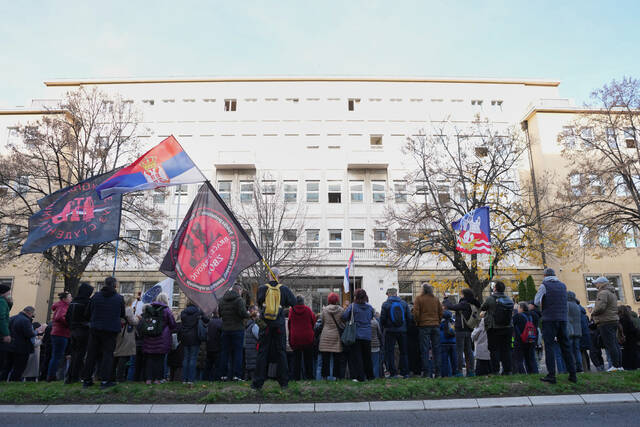
The investigation centers on a controversy over a bombed-out military complex in central Belgrade that was a protected cultural heritage zone, but that is facing redevelopment as a luxury compound.
Last year, Serbia’s government signed a 99-year-lease agreement with Kushner-linked Affinity Global Development in the U.S. At the time, Kushner confirmed reports that his company plans to finance the $500 million project. It would feature a high-rise hotel, a luxury apartment complex, office spaces and shops.
Selaković and others allegedly illegally lifted the protection status for the site by forging documentation.
It wasn’t immediately clear when a trial could be held.
The proposal to build a high-rise hotel, offices and shops at the site is backed by Vucic’s government, but has met fierce opposition from experts at home and abroad, as well as the Serbian public.
Serbian lawmakers passed a special law last month clearing the way for the construction, despite the ongoing investigation. Vučić has said that the project would be good for Serbia’s relations with the United States and that he would pardon anyone convicted in the case.
“I am guilty,” he said recently. “I am the one who wanted modernization of Serbia. I am the one who wanted to bring in a big investor.”
The U.S. administration has imposed tariffs of 35% on imports from Serbia. It has also sanctioned Serbia’s monopoly oil supplier, which is controlled by Russia.
Critics say the building is an architectural monument, seen as a symbol of resistance to the U.S.-led NATO bombing that remains widely viewed in the Balkan country as an unjust “aggression.”
Serbia was bombed in 1999 for 78 days to force then President Slobodan Milošević to end his crackdown on separatist ethnic Albanians in Kosovo. Anti-NATO sentiment remains strong in Serbia, and the U.S. role in revamping the military buildings is particularly sensitive among many Serbians.
The buildings are seen as prime examples of mid-20th century architecture in the former Yugoslavia.