

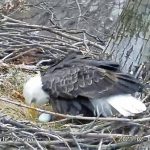
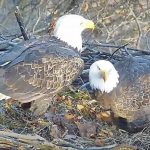
The female Pittsburgh bald eagle laid her first egg of the season Friday just before 5:30 p.m., according to the Audubon Society of Western Pennsylvania.
The Hays couple, in their 11th breeding season nesting a steep hillside high above the Monongahela River near the Glenwood Bridge, have successfully raised 18 eaglets over the years.
“They are like an old married couple now,” said Annette Devinney of Monroeville who, along with her husband, Gerry, have been photographing the pair for a decade.
“These eagles bicker, they redecorate, and he still brings her treats,” Devinney said.
The birds aren’t going anywhere.
“They’ve lost their nest three times already, and they continue to rebuild within that hundred-yard area on the hillside,” she said.
The Hays couple, the first bald eagles to nest in the City of Pittsburgh in more than 150 years, typically lay two to three eggs spaced several days apart.
Both male and female take turns around the clock incubating the eggs, which hatch in 35 days.
Last year, the Hays female laid three eggs: February 11, 14, and 17, said Rachel Handel for the Audubon Society. All three eggs hatched and three eaglets fledged the nest.
PixCams of Murrysville partners with the Audubon Society of Western Pennsylvania to offer a free livestreaming webcam of the Hays nest. The Hays webcam is in its 10th year of livestreaming.
Last year, more than 2.4 million people in 50 countries watched the Pittsburgh bald eagles via the webcam, according to Bill Powers, owner of PixCams in Murrysville.
“What I find truly amazing is how popular theses eagles still are and have become a symbol to Pittsburgh,” he said.
At last count, the bald eagle population continued to soar in 2019 with more than 300 nesting pairs in Pennsylvania — an exponential increase from the three pairs in the state in the early 1980s, according to the Pennsylvania Game Commission.
In 1967, the federal government listed the charismatic raptors as endangered when populations plummeted because of environmental pressures and the pesticide DDT, which damaged eagle egg shells. After DDT was banned in 1972, the game commission and wildlife agencies reintroduced the birds.
The eagle population took off and the birds shed the “endangered,” and later, “threatened” classifications. Because the game commission took the birds off the threatened list in 2014, they no longer count them, although they still keep tabs on the location of eagle nests.
The birds are still protected by federal law.
Nationally, the eagle population quadrupled in the lower 48 states from 2009 to 2020 with 316,700 birds and 71,400 nesting pairs, according to the U.S. Fish and Wildlife Service.
State game commission biologists expect more bald eagles to nest in Allegheny, Armstrong, Butler and Westmoreland counties in years to come.