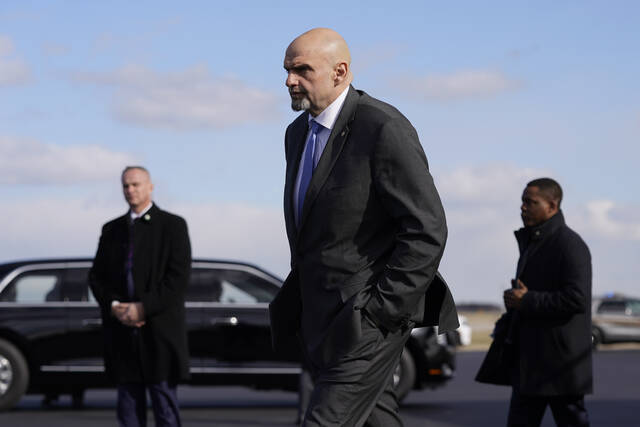
U.S. Sen. John Fetterman was released Friday from Walter Reed National Military Medical Center after being treated for clinical depression.
Dr. David Williamson, Walter Reed’s neuropsychiatry chief and medical director, said Fetterman’s depression is now in remission.
Fetterman is back home in Braddock.
“I’m excited to be the father and husband I want to be, and the senator Pennsylvania deserves,” Fetterman said in a statement.
He credited his team at Walter Reed for providing care that “changed my life.”
“I will have more to say about this soon, but for now I want everyone to know that depression is treatable, and treatment works,” the senator said. “This isn’t about politics — right now there are people who are suffering with depression in red counties and blue counties. If you need help, please get help.”
Fetterman checked himself into the hospital to receive treatment for his depression in February.
Chief of Staff Adam Jentleson said at that time that Fetterman had experienced depression intermittently throughout his life, and it had only become severe recently.
Fetterman suffered a near-fatal stroke in May and has since struggled with auditory processing issues.
With the Senate in recess for the next two weeks, Fetterman is planning to spend time with his family and constituents in Pennsylvania.
He plans to return to Washington, D.C., when the Senate session resumes on April 17.
According to the American Stroke Association, depression is common for stroke survivors, and is often caused by biochemical changes in the brain resulting from a stroke.
A 2016 scientific statement from the ASA indicates that about one-third of stroke survivors experience depression, compared to 5%-13% of adults without stroke.
Dr. Bruce Ovbiagele, editor-in-chief of the Journal of the American Heart Association/American Stroke Association, told the Tribune-Review that stroke survivors have the highest risk of depression in the first year following a stroke.