
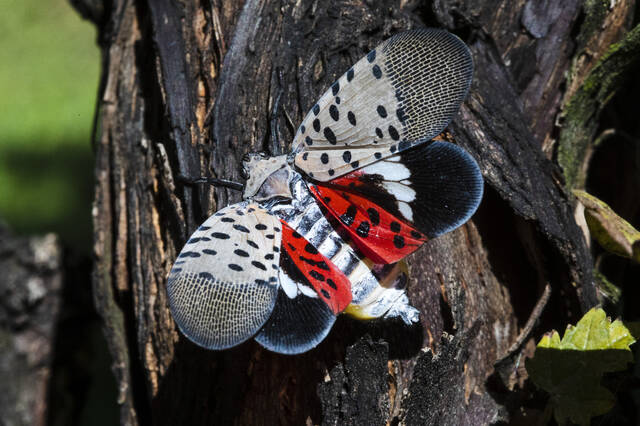
The spotted lanternfly — a beautiful but invasive plant hopper from Asia — continues its invasion of the region with a 1,722% increase in reports in Allegheny County, a 351% increase in Westmoreland County and a 177% increase in Butler in the past year.
The insect doesn’t harm people, but it’s a clear and present danger to trees and other flora. The lanternfly has a ravenous appetite for the sap of fruit, ornamental plants and woody plants and can weaken native trees and kill grape vines, according to Penn State Extension.
Lanternfly numbers skyrocketed in Allegheny County and in Dauphin County in Central Pennsylvania for two reasons, Department of Agriculture spokeswoman Shannon Power said.
“In 2020, unwitting travelers transported lanternfly hitchhikers. Before they died last winter, those lanternflies laid eggs in batches of 50 or 60. One lanternfly in 2020 turned into creepy hordes in 2021.”
The department does not track numbers of insects. It tallies and responds to reports from the public and visits the locations of infestations, which it treats.
In Allegheny County, there were 4,392 reports this year as of Nov. 1, compared to 241 in all of 2020. Westmoreland has had 149 reports this year, up from 33 in 2020. In neighboring counties, reports weren’t as prevalent: Armstrong had seven reports this year after having four in 2020, while Butler County had 36 after having 13 reports in 2020.
The Department of Agriculture’s website has simple advice for anyone who sees a spotted lanternfly: After calling 1-888-4BADFLY to report the bug, “Kill it! Squash it, smash it … just get rid of it.”
There have been numerous reports of lanterflies in Downtown Pittsburgh and on the North Shore, said Sandy Feather, an educator with Penn State Extension.
From Jan. 1 to Nov. 8 of this year, the city of Pittsburgh led Allegheny County with the highest number of lanternfly reports at 2,796. Other municipalities with numerous reports include Bellevue (245), West Mifflin (180), Avalon (110), Monroeville (76), Ross (75) and North Versailles (68), Powers said.
In Westmoreland, the communities with the most lanternfly reports between Jan. 1 and Nov. 8 are North Huntingdon (24), Manor (20), Penn (19), Hempfield (11) and Greensburg (11), Powers said.
Statewide, lanternfly reports have dropped about 50% from 2020 to Nov. 1 of this year. The reason for the statewide drop in reports is unclear and under review by Penn State, she said.
One possible reason for the dramatic decline in reported cases statewide is that more people reported them in 2020 when they worked from home during the height of the covid-19 pandemic, Powers said.
In addition, in the sections of eastern Pennsylvania where the lanternfly is common, the public doesn’t report the insects as much as they used to.
Yet another possibility for the population decline statewide could be the weather, said Amy K. Korman, who has been an entomologist for 40 years and is a horticulture extension educator for Penn State Extension in Northampton and Lehigh counties.
“This year was weird, with a prolonged hot spring and then a monsoon season in August and September,” she said.
“I don’t know if what we are seeing is a reflection of the crazy weather or a natural waxing or waning of a population,” Korman said. “We don’t have enough data.”
“Reports of the lanternfly are an indication of public awareness,” she said. “The public is starting to recognize the insects in Allegheny County.” The presence of the distinctive-looking adults, coupled with the public’s knowledge of them, allows residents to make accurate identifications and reports, Powers said.
Because the insect does not travel great distances on the wing, it moves to new areas by hopping onto something that travels, such as a car or train, she said.
Each egg mass laid by one lanternfly produces 50 to 60 young, Powers said. The egg masses look like smears of gray or brown concrete. They are 1½ inches long with rows of small eggs, roughly the size of sharpened pencil points, according to Penn State Extension.
“That’s why it is important over the winter months to look at outdoor furniture, rocks and tree branches to scrape and kill those egg masses,” Korman said.
Experts recommend scraping the egg sacs into a container with alcohol or sanitizer, or squeezing the egg masses to destroy them.
The adult lanternfly will stay out until a series of hard freezes kills them. By this time of year, the lanternflies have laid egg sacs, which will hatch in May and June.
Allegheny and Westmoreland counties are designated lanternfly quarantine areas, where residents are asked to find and get rid of the invasive pests.
Annual economic damage from the insect in the southeastern part of the state, where it is established, is estimated at $50 million per year with a loss of 484 jobs, according to a 2020 Penn State study. The hardest hit are fruit growers — especially grape growers — and Christmas tree growers.