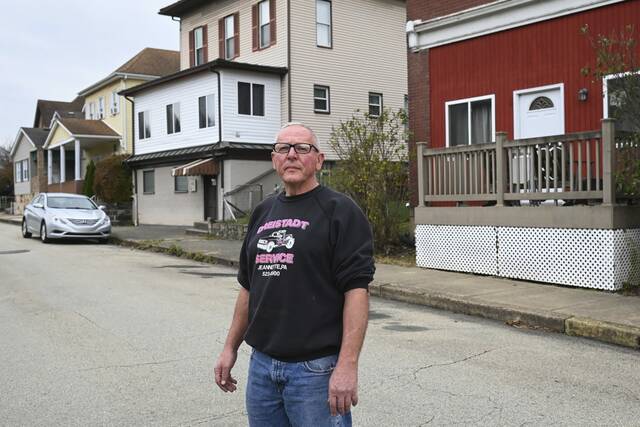


When residents stumble upon a tree blocking a roadway in Penn Borough, Randy Dreistadt is the first person they call.
He’s also the person who handles parking issues, clogged storm drains and rentals of the town’s park pavilion.
When snow coats the borough’s roads in the winter, chances are Dreistadt is bundled up, braving the icy conditions to man the snowplow.
Dreistadt has been council president of the 0.2-square-mile borough for 40 years and a volunteer firefighter for the community for 50. He’s lived in the 435-resident community all 63 years of his life.
“(I) really never saw any need to move out of the community,” he said.
But much like most of the borough’s other stewards, Dreistadt largely serves his hometown on a volunteer basis.
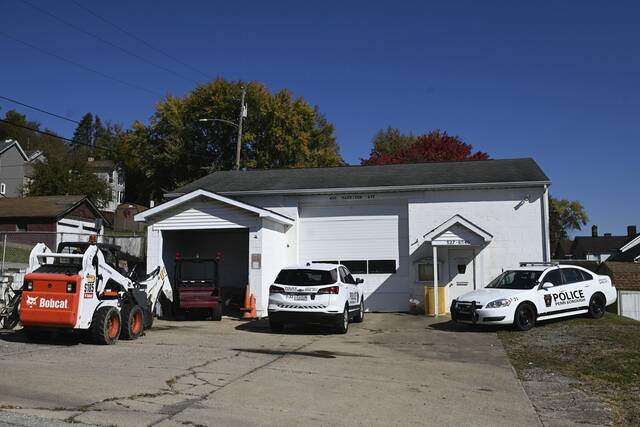
The borough employs no full-time workers, doling out part-time pay to road workers, a solicitor, a secretary-treasurer and two or three police officers. Part-time employees handle grass cutting and weed trimming in the absence of a formal public works department.
The borough is not struggling financially, Dreistadt said.
“We have no debt. We have a lot of assets, which a lot of communities can’t say that they’re debt-free,” he said. “We don’t get any tax anticipation notes to carry us over into next year due to running such a tight ship.”
The problem?
“We have a lot of people that put time in that they’re really not compensated for,” he said.
Dreistadt admits he can’t keep up with his full-time job and service to the borough forever.
“I’ll do it as long as I need to do it,” he said, “but I don’t see anyone else that’s going to step into that role to carry on that same position.”
Penn Borough approached officials from nearby Penn Township in March of last year with a potential solution — a merger of the neighboring municipalities.
Communities weigh merger
This would mean the borough would be absorbed by the 30-square-mile township. The two municipalities would form a united council and share services such as management, public works, recreation and community development — relieving the borough’s volunteers of their unpaid efforts.
Both municipalities agreed to consider a merger, later partnering with the state Department of Community and Economic Development to complete a merger study. The results were presented in late September, said Penn Township Secretary/Manager Mary Perez.
Residents of the borough and township will have an opportunity to voice their thoughts and concerns on the merger sometime in the new year.
“Nothing’s going to happen quickly,” Perez said, noting residents would need to vote on the merger in the next general election before the municipalities could proceed.
From November 1978 to November 2023, there were 18 successful mergers and consolidations across the state and 28 that fell through, according to data from the DCED.
A merger is when one community is absorbed by another. A consolidation is when two communities form one municipality under a new name.
In Southwestern Pennsylvania, Indiana County’s Jacksonville Borough voted to merge into Black Lick Township in 1992, and Washington County’s West Alexander Borough voted to merge into Donegal Township in 2008.
Last November, Lawrence County’s South New Castle Borough voted to merge into Shenango Township.
No mergers or consolidations in Westmoreland or Allegheny counties were recorded in the data.
Related:
• Wilkinsburg annexation failure reflects merger hurdles for Pa.’s 2,560 municipalities• As Pittsburgh considers studying mergers, neighboring communities say they’re not interested
• For many fire departments, merger may be the only way forward
So far, Dreistadt supports the merger.
“I would say that I’m in support of it, but I would like to hear from the rest of the community also,” he said. “All elected officials are elected to do what they feel is the best thing for the whole community, because the whole community can’t make the decisions day-to-day that we have to make.”
Like Dreistadt, most borough employees and council members have held their roles for decades. Dreistadt is unsure future generations will be willing to fill their shoes.
“It just doesn’t seem like people want to get involved with the fire departments, the local councils or the Boy Scouts or the PTO — any of the organizations. It’s just hard to get people to donate their time,” he said. “Life’s busy.”
Borough low on businesses, community events
That’s a trend that has impacted the borough in more ways than one.
Apart from the Penn Borough Park, L&I’s restaurant and bar and the Penn Rod & Gun Club, there are few businesses and gathering places in the borough, Dreistadt said.
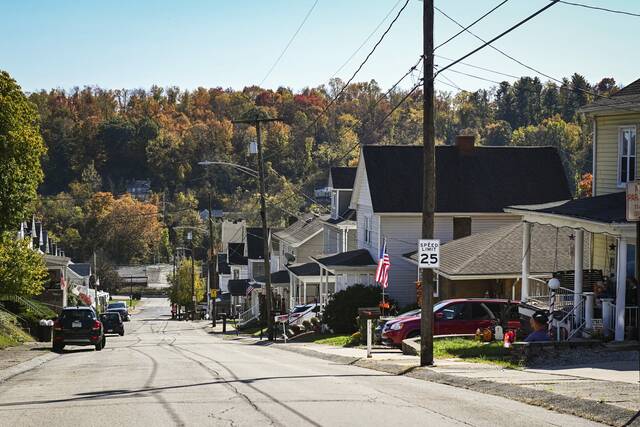
A railroad runs along a street in the southern portion of the community. The George DeLallo Co. and Bell-View Foods warehouses are tucked in among the borough’s nearly 200 residences.
The borough’s primary community event — a weeklong carnival benefitting the fire department — was discontinued a decade ago.
“It was a lot of work,” said fire department President Paul Gamble, reflecting on the late nights that went into organizing the event.
The carnival was a staple of the borough for more than 30 years, Gamble said, complete with traditional carnival rides, games, fried and grilled foods, live music, fireworks and a parade.
At its peak, the carnival brought in $10,000, he said.
But with the cost of ride rentals, reserving bands to perform and “sending profits up in smoke” with the fireworks display, Gamble said the expenses started to outweigh the benefits.
And, if rain was in the forecast, revenue dropped significantly.
“It was a lot of expense for a little profit,” said Gamble, 49, of Penn Township.
The fire department — which gets no more than 150 calls per year — has seen a decrease in membership since its founding in 1932, said Gamble, who joined when he was 14.
There are 25 members on the roster, but only about 10 who respond to calls regularly.
“With everybody having other jobs, sometimes we get eight to 10 people on the call,” he said. “Other times, we have one.”
Borough’s last church closes its doors
Three churches have left the borough in the past two decades, said the Rev. Roger Steiner, pastor of Penn-Zion Lutheran Church.
Penn-Zion once had two buildings: one along Penn Township’s Route 130 and the other on Penn Borough’s Harrison Avenue.
Steiner gave his last sermon in Penn Borough on Oct. 27, about a year after the church council voted 8-6 to close the building by the end of 2024.
The building formerly housed Penn-Zion’s outreach program, Project Hope, which has supported about 320 agencies and ministry groups around the world since its inception in 2011.
“There was some good ministry that happened there,” Steiner said.
But with only eight to 15 congregants attending services in Penn Borough each week, closing the building made the most financial sense.
“It ended up being low worship attendance and lack of funds and so forth, and it was a practical decision in all of those ways,” said Steiner, who has served Penn-Zion for about 17 years. “We can be better stewards of our money with one less building to maintain.”
The borough’s plight was foreseen nearly 60 years ago, Steiner said, citing a blurb written for the Penn Borough church on its 75th anniversary:
“The community of Penn has not been a growing community over the years,” it reads. “There are seven Lutheran churches within a five-mile radius of our church. The opportunity for growth has not been great. The pastors serving the congregation have entirely sought to bring new people to the church, tried to hold the young people in a close relationship to the congregation.”
As Steiner stood before congregants in Penn Borough for the last time, he reminded them that closing the church should not be seen as a failure.
“There was ministry that happened here in a time and a place,” he said. “There’s ministry in and out of seasons.
“Now it’s time to recognize that the ministry of Penn (Borough) has changed so much so that the ministry continues on through the work of the Penn-Zion Lutheran Church with only one building instead of two.”