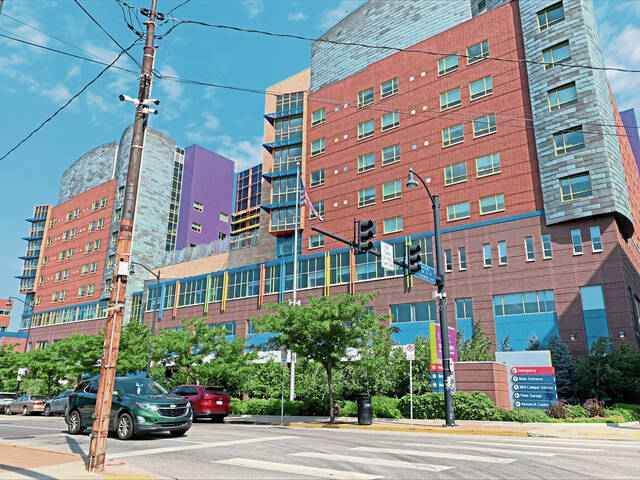


A new medical facility at UPMC Mercy Pavilion in Pittsburgh’s Uptown section will marry for the first time the disciplines of ophthalmology and rehabilitation — and top doctors in those fields — when it opens this week.
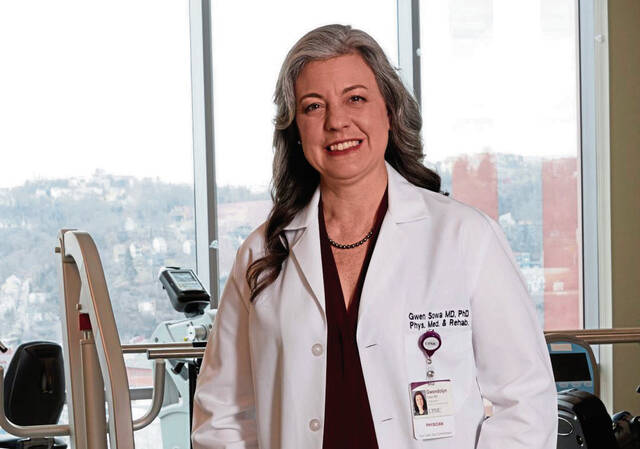
“To my knowledge, this is the first physical space that will be bringing these two disciplines together in a very intentional way,” said Dr. Gwendolyn Sowa, director of the UPMC Rehabilitation Institute. “And there’s a lot of synergy in treating people with visual impairment, mobility impairment, cognitive impairment and helping them navigate their environment and the different needs they have.”
The nine-story pavilion is the result of a 410,000-square-foot, $510 million expansion that was nearly six years in the making.
The facility on Locust Street, near Duquesne University, was announced in 2017. The project broke ground in 2019, which was the first new construction for the Pittsburgh-based health system in 11 years.
The pavilion will feature eight eye disease operating rooms, 83 eye exam rooms, 10 rehab exam rooms and 100,600 square feet of research space.
It will treat patients with visual, mobility and cognitive impairments. Its specialty areas will include cataract cornea, glaucoma and neurological care, as well as plastic surgery.
It also features a life skills apartment — outfitted with furniture, appliances and a street simulation lab.
The convergence of ophthalmology and rehabilitation represents a “strong collaboration” among the schools throughout the University of Pittsburgh and different departments within the School of Medicine, Sowa said.
“We’re intentionally putting clinicians and researchers side by side in this new space so that they can talk on a daily basis and make sure that what we’re doing makes sense to the patient and is informed by the clinical care, and vice versa. But it’s also been a really incredible collaboration with the local community. That’s been really rewarding.”
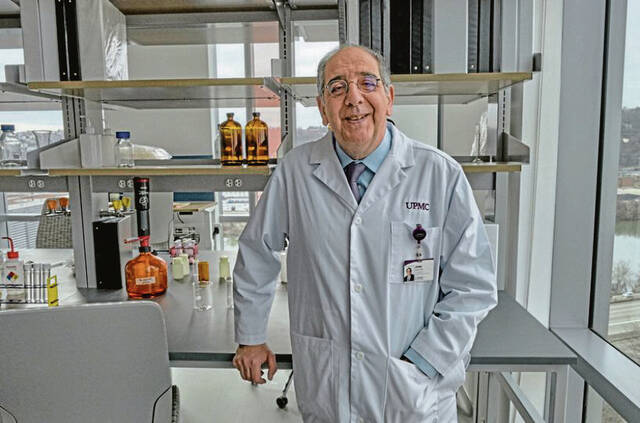
Dr. José-Alain Sahel, director of the UPMC Vision Institute, is regarded as one of the world’s top experts in retinal diseases and vision restoration research.
Sahel founded and directed from 2008 to 2020 the Vision Institute in Paris, the largest research center in Europe at that time.
By bringing research and knowledge of ophthalmology and rehabilitation together, Sahel said, the goal is patient-focused treatment.
“We are working with other universities on assessing the impact of condition to patient expectations they have, and how we can make their lives better,” Sahel said. “Something which is also very important is access to care. We have developed a large number of initiatives to provide free care to people in the area and beyond.”
Sahel said UPMC is building on existing programs to offer community support and working with nonprofits and other organizations on access to care, transportation, child care and other initiatives.
Sowa noted that there are ways that ophthalmology and rehabilitation naturally work together as disciplines. One instance is when someone has a stroke.
“A stroke can affect someone’s mobility, vision and cognition,” Sowa said. “This is an example where having all of those resources available is critical. A patient with a visual impairment may need different types of rehabilitation or novel technologies to navigate their environment that could be coupled with an assistive device or retraining their walking gait.
“There’s also been a lot of opportunities for collaboration in the science and a lot of work going on with decoding brain signals related to movement, related to sensation and also related to vision.
”So getting those scientists working together is also going to be very unique and is going to be more than ‘one plus one equals two.’ I think it’s going to change the dogma of how we think about some of these conditions.”
Sahel said his experience in Paris, as well as his experience with the health care systems in the United States and other countries, gives him a unique perspective on the medical system.
“I think this international exposure gives a good assessment of what is needed by patients across the world,” Sahel said. “People are the same, patients are the same, and we need to be very humanistic (in our) approach. At the same time, medicine has made such amazing progress and technology, especially over the last few decades. But it’s a very fast-moving field. So you need a place where you can adapt to change, to advocate for change.
“But you can never forget that a person doesn’t want to be a patient, they have to be a patient. This may seem pretty obvious, but actually it’s not so easy because we are different cultures and have different modes of thinking and getting people together.”