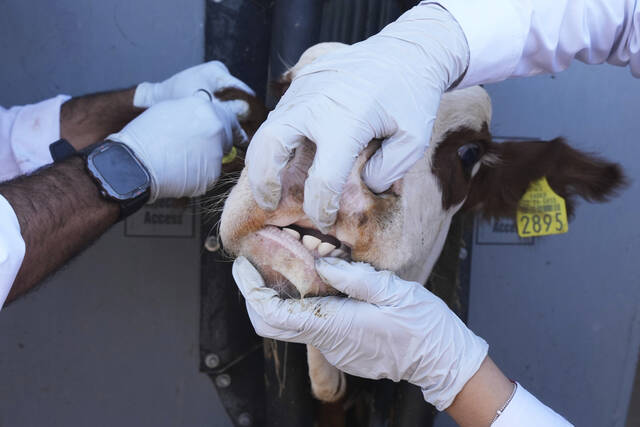





The latest threat to the southern border has wings and lays eggs that hatch into flesh-eating maggots that can kill people.
At least five Central Americans have died from myiasis of the New World Screwworm this year. Myiasis is the term used when maggots infest human flesh and cause an infection.
Belize reported its first-ever case this week, about 30 cases have been reported in both Costa Rica and Nicaragua, and Mexico has recorded at least 35 cases, including one that was fatal.
The New World Screwworm also poses an emerging threat to the nation’s food supply, U.S Department of Health and Human Services Secretary Robert F. Kennedy Jr. said in a statement.
On Tuesday, Kennedy gave the Food and Drug Administration emergency authorization to use drugs to treat or prevent infestations in animals. The authorization doesn’t apply to people.
“This authorization equips FDA to act quickly, limit the spread of New World Screwworm and protect America’s livestock,” Kennedy said.
There are no FDA-approved treatments for animals with myiasis caused by the parasite. The emergency authorization gives the FDA authority to fast-track off label uses of some drugs and/or use of drugs used in other countries.
“Our cattle ranchers and livestock producers are relying on the Trump Administration to defend their livelihoods,” said U.S. Secretary of Agriculture Brooke L. Rollins. “Stopping this pest is a national security priority and we are linking arms across President Trump’s cabinet to defend our borders and push back this threat.”
Today, @HHSGov issued a declaration that allows the FDA to issue Emergency Use Authorizations (EUAs) for animal drugs to treat or prevent infestations caused by the New World Screwworm (NWS) provided each drug has gone through a designated emergency review process.… pic.twitter.com/x1IB8cN4wd
— U.S. FDA (@US_FDA) August 19, 2025
The screwworm was eliminated from the U.S. in 1966 by exposing male New World screwworm flies to radiation, which renders them sterile.
Flies mate once in their life cycle, so these sterile males kill off the females and prevent them from laying eggs on a wound of a warm-blooded animal.
The same technique was used to eradicate them from Mexico and Central America, but in 2023 the flies breached the Darién Gap that provides a natural barrier that hampers most anything from coming north from South America.
It’s taken about two years for the flies to reach Oaxaca, the Mexican state just south of Mexico City.
The U.S. Department of Agriculture is also spending $750 million to build a plant in Edinburg, Texas, near the Mexican border to breed sterile male flies.
The parasites likely will never make it to Pennsylvania, a Penn State insect expert previously told TribLive.
“We can and have gotten it under control,” said Michael Skvarla, a Penn State professor who specializes in identifying bugs.
“It is really concerning,” Skvarla said, but he added that they shouldn’t spread to Pennsylvania.
Related:
• Allegheny County Health Department confirms first human West Nile case of year• What's bugging you if it isn't a mosquito
• Researchers using scent dogs to sniff out eggs of invasive spotted lanternfly