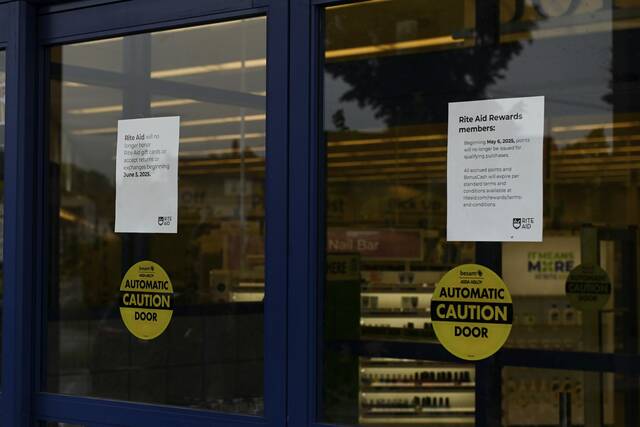
If you have been in a Rite Aid in recent months, the news of store closings was probably not a surprise.
Many shelves are barely stocked. Outside of the pharmacy, the stores often have a ghost-town appearance.
So when the company filed for Chapter 11 bankruptcy this month and began listing closing dates for stores, there was little shock.
It was, however, the most recent disappointment for people who depend on prescription drugs.
Rite Aid has 1,240 stores. All are planned for either outright closing or sale as the company unloads assets.
This is nothing new. Rite Aid, which was founded in Scranton in 1962, is a crazy quilt stitched out of mergers and acquisitions over the years, including Eckerd Pharmacy, born in Erie, and Pittsburgh’s own Thrift Drug.
To be clear, there were many who never liked the idea of Frankensteining the corpses of dying drugstore chains into ever-larger monoliths. The Federal Trade Commission didn’t like the $3.5 billion deal with Eckerd and Brooks stores added to the mix, prompting a 2007 consent order for some locations to be sold to competitors like Walgreens or Weis Markets.
But that was when there seemed to be a major drug store on every corner, not to mention a pharmacy in every grocery store and mom-and-pop independents still striving to serve their own niche.
Today, most seem to be gasping for breath.
In 2024, southwestern Pennsylvania was hit with a rash of closures, as multiple small chains and independent pharmacies closed their doors. They cited problems including pharmacy benefit managers — the middlemen standing between insurance companies and drug stores — and low reimbursement rates. The closures were sudden and unexpected, and they left customers scrambling.
There have been efforts to address the pharmacy benefit manager issue, with Pennsylvania’s General Assembly showing a rare moment of bipartisan workmanship to pass a law restricting some of the more predatory practices.
But as the already near-vacant Rite Aid stores close, the problem becomes less about the behind-the-scenes business of prescription drugs and insurance and more about the simple issue of access.
The law of supply and demand tells us that fewer opportunities to buy something drives up the price. With many pharmaceuticals, the real price is more than money. It’s life or death.