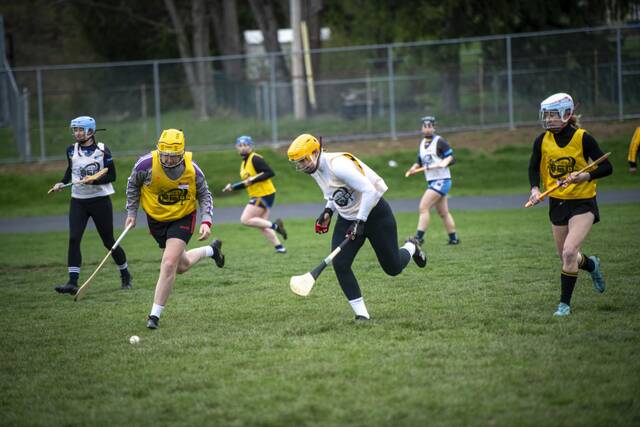
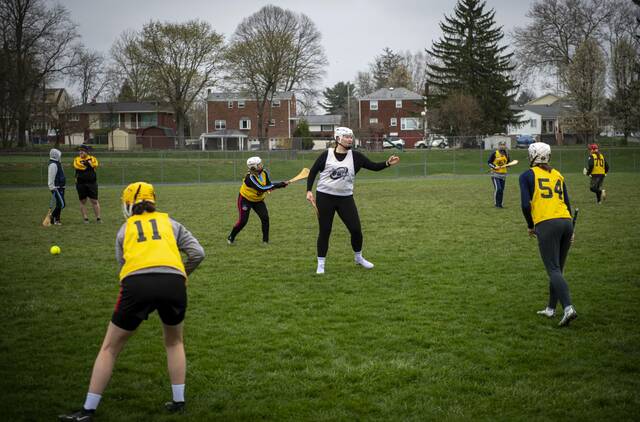
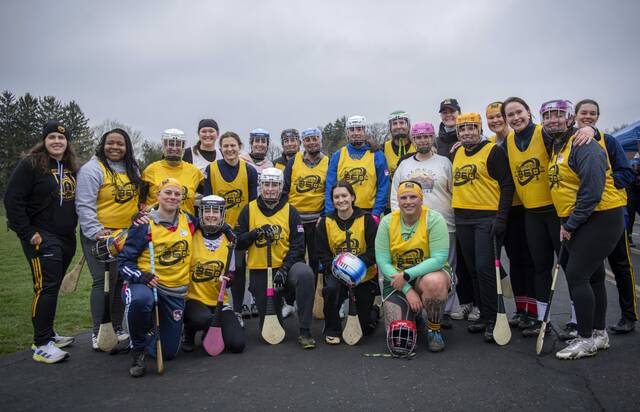
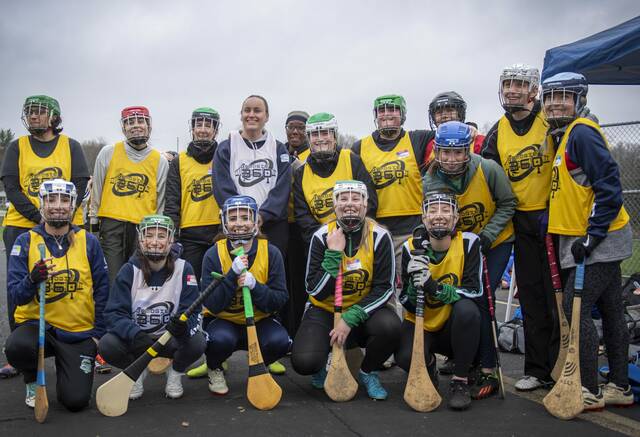
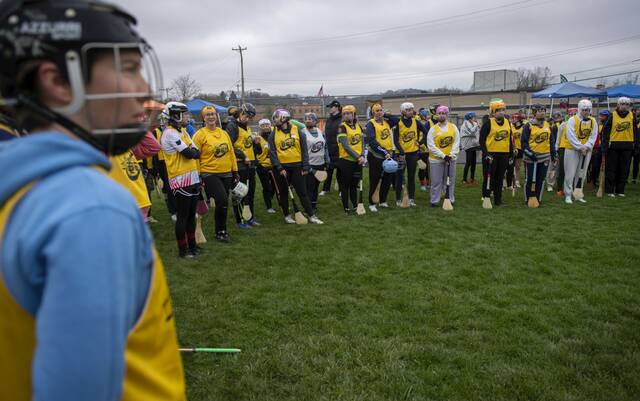
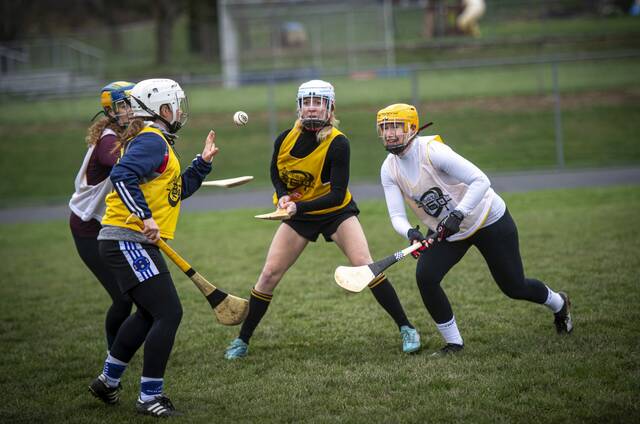
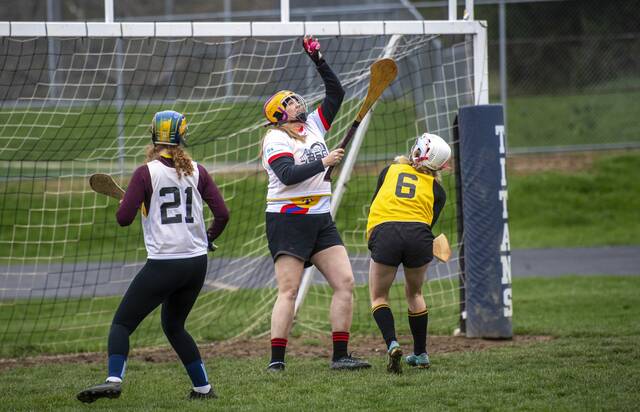
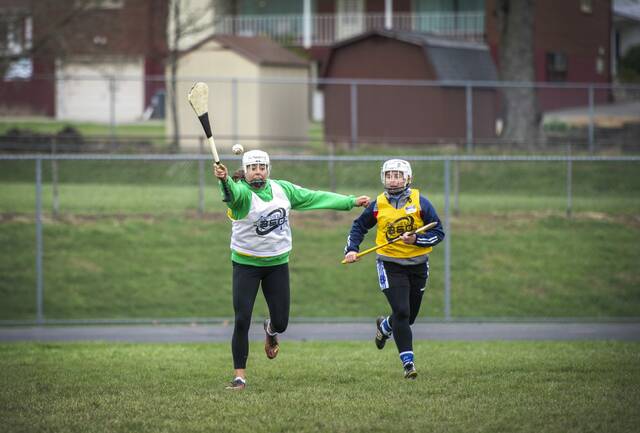
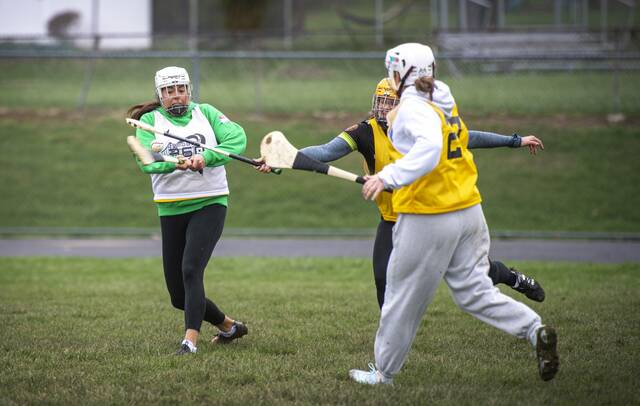
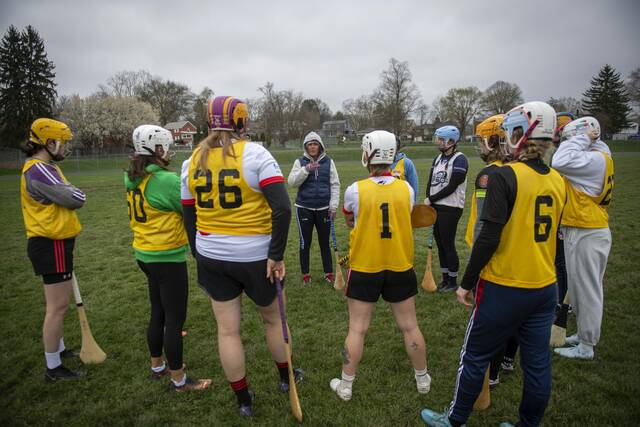

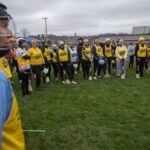
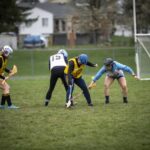
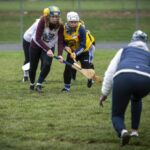
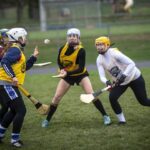
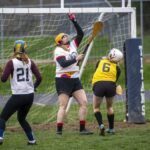
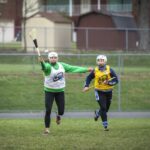
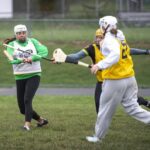
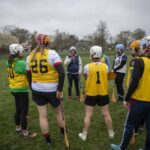
About 100 women from all over the nation have gathered in Shaler this weekend to hone their skills at what’s called “the fastest game on grass.”
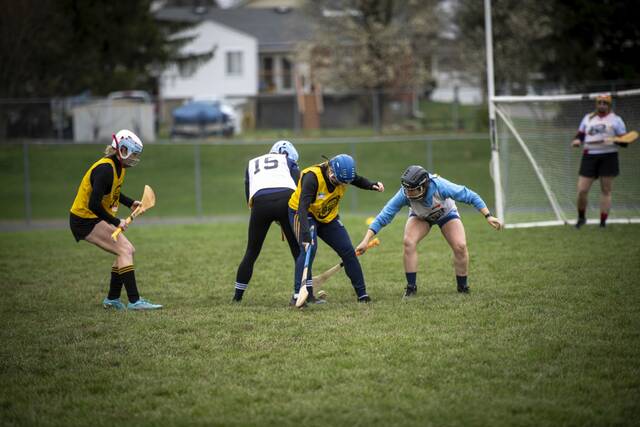
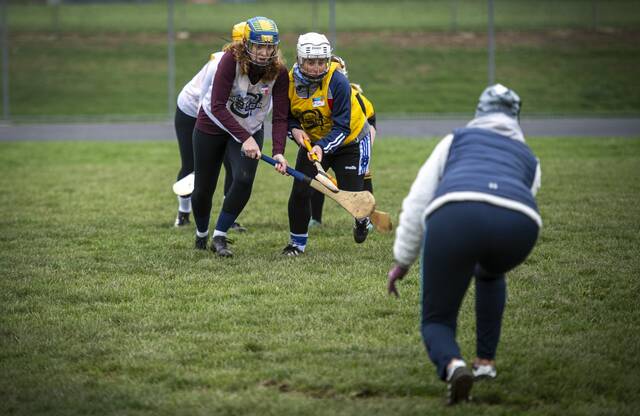
They’re playing the ball-and-stick sport “camogie,” described as a combination of field hockey and lacrosse and the women’s version of hurling, which is widely considered Ireland’s national sport.
“It’s an ancient sport that’s been played for thousands of years, so it has deep roots in the Irish culture,” said Kaitlin McCafferty, 35, a teacher at Woodland Hills who will play on Pittsburgh’s team, Na Laochra, this season. A resident of Swisshelm Park, she was practicing with the newcomers to the sport.
“It’s really fun. It’s nice to be able to refine our skills,” she said. “I definitely can feel myself improving.”
This is the fourth year for the Camogie 360 Development Weekend, and the first time it was held in Pittsburgh. The players are preparing for the season that will run from May to August, said Emily Earnest, co-chair of the United States Gaelic Athletic Association’s camogie development work group. She’s a captain on Na Laochra, which was founded in November 2021.
A 34-year-old physical therapist from Shaler, Earnest has been playing for nine or 10 years after being introduced to the sport.
“I had a friend in college I played quidditch with,” she said. “I moved to a sport no one knows about, but it’s real — and way more awesome.”
Anyone interested in learning more about the sport can see matches between 9 a.m. and 1 p.m. Sunday when the players return to the fields at Shaler Area Elementary School, 700 Scott Ave.
Conner Bennett, 27, an industrial engineer, came from San Francisco to attend the development weekend. She was introduced to camogie when she was a grad student at the University of Pittsburgh.
“It looked really fun. It was so fast,” she said. “It’s just kind of addicting when you get into it. I never played a sport like it before.”
While this year will be her third season on her team, Cu Chulainn, Bennett had never been to a development weekend before, and she wanted to come back to Pittsburgh.
“It’s a great start to the season,” she said.
Damon Margida, a Castle Shannon native, is the manager and coach of the Cleveland hurling and camogie team, the Pittsburgh team’s rival. A police officer, he founded the Cleveland men’s hurling team five years ago and the women’s camogie team the following year.
“It’s a very pure sport, an amateur sport,” he said.
Margida called camogie a “tougher” version of lacrosse, using the skills from that sport as well as hockey, soccer and field hockey.
On the field, each team has 13 players, which differs from 15 in Ireland.
The goal resembles a soccer net combined with a football goalpost, and there are two ways to score — getting the ball, called a sliotar, into the net scores three points, while getting it through the uprights is good for one.
“This sport is very unique as well,” Margida said. “This is called the fastest came on grass. This game moves very quickly. You can never be asleep. There’s no pause. You have to always be alert.”
Besides being a way to stay physically active, many of the players said they’ve also found it’s a way to make friends, something often not easily done for adults.
“It brings a lot of people together you wouldn’t normally see,” said Kelly Kirk, a player from Charlotte, N.C., who will coach this year and works for a company that makes medical devices used in open heart surgeries. “It’s super welcoming, especially since it’s just growing here.”
It was the friendships that made playing camogie better than Siobhan Popp thought it would be. The 34-year-old chiropractor who lives in Downtown Pittsburgh is now a former player after an injury, but chairs Pittsburgh’s team.
“It’s still fun to be involved,” said Popp, who began playing after moving from Boston to Pittsburgh in 2019. “This is a great way to find friends as an adult. Some of these girls are my best friends now.”
New players are always being sought for the new, growing sport, Earnest said.
Bennett suggested any women with an interest to give it a try.
“Even if you’ve never picked up a hurl, just try,” she said. “The best decision I ever made was to go to a practice and see what it’s all about.”